
By Vickie Lockett +impact Partner
As global air travel accelerates, airports face a new challenge: how to deliver hyper-personalised, human-centred passenger experiences at scale, without compromising efficiency, safety, or service excellence.
It’s a complex balancing act that demands more than new technology. It requires a deep understanding of behaviour, design, and operations and an ability to connect all three into a seamless journey.
At +impact, we’ve learned this first-hand through our partnership with Dubai Airports, where we’ve helped reimagine the airport journey from the inside out. Drawing on Serco’s decades of operational expertise, we don’t just design experiences; we make them work in practice, turning strategy into operational reality.
Because true transformation isn’t theoretical. It’s lived, operational, and measurable.
A Growing Industry, Rising Expectations
Global air travel continues to climb. In 2024, passenger traffic reached 9.5billion, surpassing 2019 levels for the first time, while international travel grew 13.6% year-on-year. Dubai International Airport alone welcomed over 92 million passengers (its highest figure on record.)
As volumes grow, so do expectations. According to IATA’s latest Global Passenger Survey, 70% of passengers expect to reach their gate within 30 minutes when travelling with hand luggage.
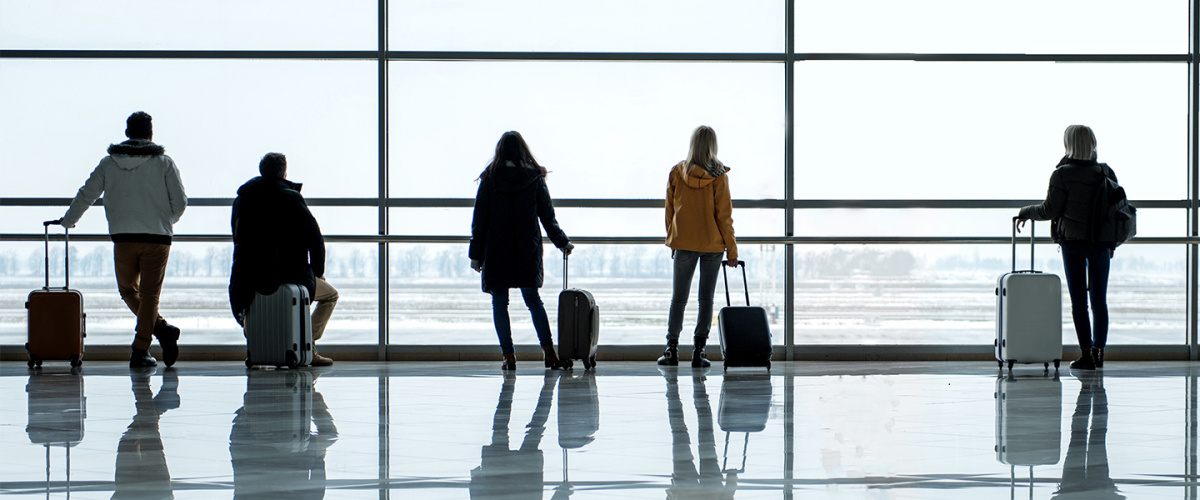
At the same time, research from Airport Dimensions shows that 83% of travellers want better seating, 79% want to see less queuing, and 71% would prefer a single digital platform that manages everything from wayfinding to retail and lounge access.
The task for airports is no longer just to move people efficiently, it’s to move them effortlessly.
Personalisation Is No Longer a Perk
Passengers now expect journeys that feel designed around them; real-time updates, tailored retail offers, biometric fast-track, seamless digital journeys. However, genuine personalisation isn’t about offering more choice; it’s about offering the right one, at the right moment. That requires understanding what passengers are thinking, feeling and doing at every stage of their journey.
This is where behavioural-led design becomes a strategic tool.
Behavioural-Led Design:
Seeing the Journey Through Human Eyes
Airports are emotional environments, home to anticipation, anxiety, excitement and exhaustion, often all within minutes. Yet many are still designed around operational flow rather than human experience.
Behavioural-led design starts by mapping the emotional journey. It’s about identifying friction, confusion and delight points along the way. With these insights, we can create experiences that:
- Reduce cognitive load through intuitive wayfinding and clear digital prompts.
- Lower stress with consistent communication and calm, sensory design.
- Enhance flow by aligning services to intent, whether passengers are rushing, waiting or exploring.
- Build trust by recognising returning travellers and tailoring experiences to preference.
These aren’t aesthetic extras, they’re performance levers that drive satisfaction, loyalty and commercial outcomes. When airports get this right, the impact goes far beyond satisfaction scores.
A well-designed experience strengthens brand loyalty and drives measurable commercial returns, from higher retail spend and dwell-time engagement to improved on-time performance. In other words, happier passengers don’t just feel better; they perform better for the airport too.
Research from J.D. Power shows that passengers who rate their airport experience as “excellent” spend on average US $16 more in-terminal than those who rate it as “average.”
Data-Driven, Human-Led
Personalisation at scale relies on data, from predictive analytics and queue management to dynamic content delivery. But while data fuels efficiency, trust sustains it.
That means:
- Transparent consent and privacy safeguards.
- Ethical use of profiling and automation, with human oversight.
- Designing for empowerment, not surveillance.
The goal isn’t to replace human interaction; it’s to amplify it — using data to make every touchpoint more relevant, responsive and respectful.
Scaling Seamlessness
Delivering tailored experiences for a few premium travellers is one thing. Doing it for tens of millions of passengers, across languages, cultures and confidence levels, is another.

Success depends on systems that are:
Modular - enabling flexible, context-aware personalisation.
Interoperable - connecting airlines, retailers, border control and ground services.
Resilient – adapting in real time to disruption, delay and surge.
It also depends on people. A seamless passenger journey is only possible when the employee experience is equally well designed.
That’s where +impact and Serco bring a unique advantage. We combine strategic advisory expertise with hands-on operational delivery, helping clients not just reimagine the airport journey but realise it.
The Future Is Human-Centred
The airports that will lead the next decade are those that understand this: personalisation is not about technology alone. It’s about empathy, design and trust.
Journeys should respect time, reduce stress, and offer moments of calm and control. They should make people feel seen, even in the world’s busiest environments.
At +impact, we believe the future of aviation lies in experiences that are not only seamless and scalable, but fundamentally human-centred that are designed with insight, delivered with precision, and sustained by people.